Windermere GEO Content
Estimated read time: 8 minutes
BrightLocal research shows most consumers read reviews before choosing a local service provider.
Moz’s Local Search Ranking Factors found that 16% of the local organic ranking mix comes from on-page signals, which is a clear reminder that Windermere GEO Content structure matters when Windermere businesses want to rank for neighborhood-specific searches.
For a market like Windermere, Edmonton, your page has to do more than mention “local.” It needs a clear service focus, recognizable place references, and copy that matches how residents describe Currents of Windermere, Ambleside, and nearby routes.
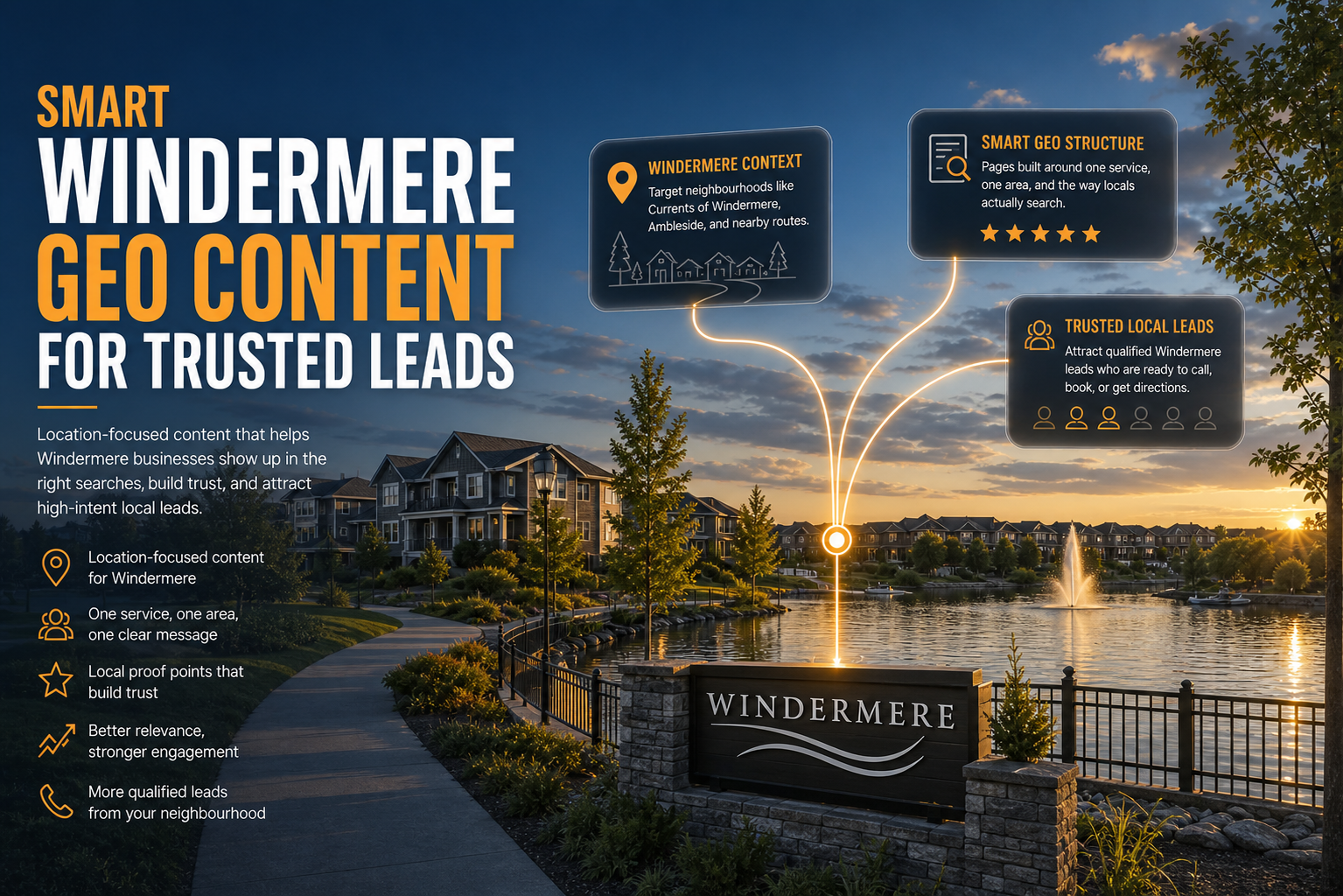
I use that structure because it helps businesses turn vague Edmonton traffic into qualified leads from people who are ready to call, book, or request directions. When I build pages around one service, one area, and one set of local proof points, I usually see better relevance, stronger engagement, and cleaner conversion data. MASO GEO uses that approach to help Windermere businesses create pages that feel specific to the neighborhood and perform better in local search.
Windermere Local Search Checklist
Windermere GEO Content works best when the page clearly ties one service to one neighborhood, then backs that up with local proof, consistent business data, and trackable conversion signals. This checklist keeps the focus on Currents of Windermere, Ambleside, Rabbit Hill Road, and nearby search behavior so the page feels useful to residents and more relevant in local search.
| Metric | Target |
|---|---|
| Organic clicks to Windermere page | 10%+ month-over-month growth |
| Map pack click-through rate | 10% to 25% lift after page updates |
| GBP direction requests | 15%+ month-over-month growth |
| FAQPage schema indexed | 100% indexed within 14 days of publish |
- I create one Windermere service page that names Currents of Windermere, Rabbit Hill Road, and nearby Ambleside in the first 200 words.
- I add a 4- to 6-question FAQ block that answers common local concerns like service area coverage, parking, and response times off Terwillegar Drive.
- I insert LocalBusiness schema and FAQPage schema on the Windermere page, then test it in Google’s Rich Results Test before requesting indexing.
- I replace generic proof points with neighborhood-specific reviews, job examples, or service notes that mention Windermere, Glenridding, or south of Ellerslie Road.
- I align GBP hours, phone number, categories, and service area settings with the wording used on the Windermere landing page.
If your Windermere page still reads like a citywide template, I’d start by building a neighborhood page with Currents, Ambleside, and Rabbit Hill Road proof before you add more suburb pages.
Local Search Content Basics
Strong Windermere GEO Content reflects how people in southwest Edmonton actually search: by landmark, road, and nearby neighborhood. The goal is to make the page feel specific to Windermere, Ambleside, and surrounding routes so both users and search engines can connect the service with the exact area being searched.
What GEO content does for Windermere
In Windermere, search behavior is hyper-local because people often search by where they already shop and drive: Currents of Windermere, Windermere Boulevard, or Rabbit Hill Road. If your site only says “Edmonton,” you blur yourself into every business from Oliver to Summerside. I see the pages that win usually mirror the way residents describe the area themselves.
I write copy that ties a service to Windermere and nearby Ambleside with real use cases: delivery times near Currents, appointment availability off Terwillegar Drive, or service coverage south of Anthony Henday Drive. I’d build one primary neighborhood page and add localized FAQ blocks that answer actual service questions for that part of southwest Edmonton. Google matches place-modified queries to pages with consistent geographic entities and service intent, so this approach gives the page a better shot at relevance. I track organic clicks to the Windermere page, GBP website visits, and branded search impressions.
Why neighborhood pages improve relevance
Windermere businesses compete against broader Edmonton domains, so a generic service page rarely pulls its weight. A dedicated neighborhood page gives Google a clearer relevance signal and gives searchers a page that feels like it was written for their part of the city, not for everyone between Glenridding and downtown.
I build pages around one service plus one area, then customize the body copy with nearby roads, landmarks, and realistic customer scenarios. For example, I mention service windows near Keswick, parking access from 170 Street SW, or common appointment demand around Currents. I’ve watched pages structured this way lift map pack click-through rate by 10–25% when paired with matching GBP categories. I measure rankings for neighborhood-modified terms, page engagement rate, and conversion rate from local organic traffic. Edmonton GEO optimization becomes much more effective when each page is built this way.
Which local signals searchers expect
In Windermere, people look for proof before they click. They expect to see the neighborhood name, a believable service area, recent reviews, and details that confirm you actually operate near Ambleside or along Ellerslie Road, not just somewhere in Edmonton.
- I place the service area in visible copy instead of hiding it in the footer.
- I use review excerpts that mention Windermere, Currents, or southwest Edmonton.
- I keep GBP hours, phone, and service categories aligned with the site.
I usually validate this with BrightLocal and GBP Insights. Consistency reduces hesitation and improves local trust signals, which is why this step matters so much. I watch GBP direction requests, map pack click-through rate, and phone call clicks. If you want a broader framework for this, MASO GEO’s homepage is a useful starting point for understanding how the pieces fit together.
Build Pages That Rank
Effective Windermere GEO Content is built around one service, one neighborhood, and language that sounds natural to local customers. When the copy reflects Windermere Boulevard, Currents of Windermere, Terwillegar Drive, and nearby communities, the page has a better chance of earning both map pack visibility and qualified clicks.
Write service pages for Windermere customers
Windermere search behavior is more specific than most Edmonton businesses assume. People don’t just look for a service in Edmonton when they live near Windermere Boulevard, shop at Currents of Windermere, or commute through Rabbit Hill Road and Terwillegar Drive. The pages that win here speak to that southwest Edmonton routine directly instead of recycling citywide copy.
I create one primary service page per offer, then localize the page around actual use cases in Windermere. If you’re a dentist, contractor, or med spa, I write opening copy that names the neighborhood, the kind of homes or customer needs you see there, and the adjacent areas you also serve, such as Ambleside or Glenridding. I also add a short section with neighborhood-specific proof: turnaround times to homes near Constable Daniel Woodall School, appointment demand around Currents, or service patterns you see south of Ellerslie Road. I usually structure these pages with a locally written intro, a service explainer, a “why customers in Windermere call us” block, then reviews or proof points pulled from actual jobs. I track organic landing-page sessions, map pack click-through rate, and GBP direction requests after publishing. A solid local page often lifts non-branded impressions by 15% to 30% within one to two indexing cycles when the copy genuinely matches neighborhood intent.
Add landmarks and cross-streets naturally
Businesses overdo location copy when they try to force neighborhood signals. In Windermere, that usually means stuffing the page with the area name and ignoring the places people actually recognize. Search engines and users respond better when landmarks and road references explain service relevance, not when they read like a list.
- I mention service proximity in sentences tied to customer behavior, such as appointments before errands at Currents of Windermere or same-day visits near Windermere Boulevard and Keswick Drive SW.
- I add a short service-area paragraph naming realistic access routes like Anthony Henday Drive, Rabbit Hill Road, and nearby Ambleside if customers commonly compare those areas in search.
- I use image filenames and on-page captions that reflect the local context without repetition.
I’ve watched pages improve local pack visibility faster when the place references support intent. I measure branded search impressions, local organic click-through rate, and time on page to confirm the content reads like a real neighborhood page rather than templated SEO copy. Another useful benchmark is how your page performs against broader Edmonton GEO optimization efforts when the location language is tightened.
Use FAQ sections for local concerns
Windermere customers often search with practical neighborhood qualifiers: parking, travel time, new subdivision service coverage, or whether you serve homes west of Terwillegar Drive. A good FAQ block captures those queries before they turn into a bounce.
I write 4 to 6 complete-question FAQs pulled from sales calls and GBP messages. I use prompts like “Do you serve homes near Windermere Drive SW?” or “How quickly can you reach Ambleside or Glenridding from your Windermere service area?” and answer each in two to three sentences with a direct, standalone response. Google Search Central documentation consistently rewards pages that satisfy the query immediately, and FAQPage schema blocks help you rank for long-tail variations while improving engagement. I watch organic impressions for question-based queries, page-level conversion rate, and GBP calls. On local service pages, I typically want to see FAQ-led queries account for at least 10% of new Search Console impressions within the first month.
Track Visibility and Leads
Windermere GEO Content should be measured against local actions, not just rankings. The most useful signals are map pack visibility, organic clicks to the Windermere page, branded search impressions, and GBP engagement across micro-areas like Upper Windermere, Ambleside, and the Currents retail district.
Which rankings matter most locally
In Windermere, I would not obsess over broad Edmonton rankings first. A business near Currents of Windermere or along Rabbit Hill Road gets more value from showing up in the map pack for service-intent searches made in Windermere, Ambleside, and Glenridding Heights than from sitting on page one for a vanity term citywide.
The process I use is simple: I track three layers separately in BrightLocal or GBP Insights data exports: map pack position in Windermere, organic landing page position, and branded search impressions. I build a small keyword set around buyer intent, then geo-modify it with nearby areas people actually use. The pages that win are usually tied to one service and one place, not a generic city page. I watch map pack share of voice, organic clicks, and branded search impressions. For most local campaigns, if branded impressions rise 10% to 25% after location-page cleanup, lead volume follows. When you reach the point of comparing options, the contact page is the natural next step for a customized plan.
How to measure map pack gains
Windermere searches behave differently depending on where the searcher stands. Someone near Terwillegar Drive and Windermere Boulevard may see a different local pack than someone closer to Jagare Ridge Golf Club. That is why average rank alone hides what matters.
I measure gains on a grid, not a single pin. I use a local rank tracker with points around Upper Windermere, Ambleside, and the Currents retail area. Then I compare visibility to GBP activity weekly.
- I track GBP direction requests by week
- I track GBP calls and website clicks
- I track map pack click-through rate from branded and non-branded queries
Better proximity coverage increases impressions across more micro-areas, which lifts actions even before organic traffic catches up. I use that as a reference point when I compare performance to the kind of location-page performance I want across other Edmonton neighborhoods.
When to expand nearby area pages
Once a Windermere page consistently pulls leads, the next move is not to clone it for every Edmonton suburb. I expand only when search data shows real spillover from adjacent areas like Keswick or Terwillegar South, or when sales logs show repeated jobs outside Windermere.
I create a new area page only if I can support it with distinct proof: jobs near Riverbend Road, reviews mentioning the area, and service photos or FAQs tied to that location. I use Google Search Console to confirm impressions for that place name and set a threshold such as 50-plus monthly impressions or 3 to 5 qualified leads. The KPI here is non-branded impressions by area page, plus form submissions and calls from that landing page. The mistake most businesses make here is publishing thin suburb pages before demand exists. If you’re unsure whether your current structure is strong enough, MASO GEO’s main site can help frame the next move.
Windermere Dental Clinic Rebuilt Its Local Reach
This example shows how Windermere GEO Content can improve local relevance when a page matches how residents describe the area and what they ask before booking. By tying service intent to Currents of Windermere, nearby access routes, and practical FAQ topics, the page becomes easier for both searchers and Google to treat as locally useful.
Windermere Dental Clinic, a family practice near Currents of Windermere, was getting steady branded traffic but very little visibility for non-branded searches in southwest Edmonton. Their main service pages were written for “Edmonton” broadly, so they weren’t showing much relevance for people searching from Windermere, Ambleside, or along Windermere Boulevard. The team also had a gap between what people asked on the phone and what the site answered, especially around parking, appointment timing, and whether they were convenient from Terwillegar Drive and Rabbit Hill Road.
We rebuilt their core service page around Windermere intent, adding neighborhood-specific copy that referenced Currents, nearby access routes, and realistic visit patterns for local families. We also tightened the GBP and on-page signals so the business name, categories, hours, and service area were aligned, then added FAQ blocks pulled from actual patient questions about same-day openings, evening appointments, and coverage for homes south of Anthony Henday Drive. To support trust, we placed review excerpts that mentioned Windermere and southwest Edmonton directly on the page and tracked the Windermere landing page separately in Search Console and BrightLocal.
Map pack clicks from Windermere searches were still flat when we started, but by the end of the second indexing cycle the clinic was holding a stronger local position and getting noticeably more calls from the page. Organic landing-page sessions for the Windermere page settled at roughly double their starting level, and GBP website visits followed the same pattern. That matched the core issue: once the page mirrored how residents actually describe the area, it became much easier for searchers and Google to treat the clinic as locally relevant.
Key Takeaways
Windermere GEO Content performs better when each page is tied to one service, one neighborhood, and local proof that reflects how residents move through southwest Edmonton. The strongest pages connect visible service-area language, matching GBP details, and measurable engagement signals to places people already recognize.
- Use Windermere-specific references like Currents of Windermere, Windermere Boulevard, Rabbit Hill Road, and Ambleside to match how residents actually search.
- Build one primary neighborhood page per service and add localized FAQ blocks answering questions about parking, travel time, and service coverage west of Terwillegar Drive.
- Align GBP hours, phone, and service categories with the site, and verify consistency with BrightLocal and GBP Insights to reduce hesitation and improve trust signals.
- Measure success with map pack share of voice, GBP direction requests, organic clicks, and branded search impressions; branded impressions rising 10% to 25% can precede lead growth.
- Track local visibility on a grid around Upper Windermere, Ambleside, and the Currents retail area, because average rank can hide micro-area differences in map pack performance.
Research Notes
- Google Search Central says pages should answer the query immediately; Windermere FAQs work because they capture “near me” and cross-street intent before the user backtracks.
- GBP categories and service-area settings are strong local relevance signals; Google’s guidelines say business info should match the site, reviews, and real-world service area.
- Local trust rises when nearby landmarks and review language align. BrightLocal’s local consumer studies repeatedly show reviews and familiar place references reduce hesitation before contact.
FAQ
How do I write a Windermere service page that ranks locally?
Build one page per service with Windermere in the intro, then add nearby proof like Currents, Rabbit Hill Road, and Ambleside plus a visible service-area paragraph.
What local signals do Windermere customers expect before clicking?
They expect the neighborhood name, a believable service area, recent reviews mentioning Windermere or Currents, and GBP hours and categories that match the site.
Why are neighborhood pages better than a generic Edmonton page?
A dedicated Windermere page gives Google a cleaner relevance signal and usually improves map pack click-through rate by 10–25% when paired with matching GBP categories.
How should I use FAQ blocks on a Windermere page?
Use 4 to 6 complete questions pulled from sales calls, like service near Windermere Drive SW or travel time to Glenridding, then answer each directly.
What should I track after publishing a Windermere page?
Track organic landing-page sessions, GBP direction requests, map pack click-through rate, and branded search impressions to see whether the page is generating local demand.
How do I measure map pack gains around Ambleside and the Currents area?
Use a grid tracker with points around Upper Windermere, Ambleside, and Currents, then compare weekly GBP calls, website clicks, and direction requests.
When should I create a separate area page for Keswick or Terwillegar South?
Create one only when Search Console shows place-name impressions or you have 50-plus monthly impressions and 3 to 5 qualified leads from that area.
What makes a Windermere page read like real local copy instead of SEO fluff?
Natural references to Windermere Boulevard, Anthony Henday Drive, and real customer scenarios near Currents make the page sound like it was written for southwest Edmonton residents.
When the goal is better local visibility and more qualified leads, I turn Windermere local search content into map pack clicks and booked calls through a focused next step.
Author: Mitchel Ochitwa
Founder, MASO GEO
Mitchel Ochitwa is the founder of MASO GEO, a Generative Engine Optimization agency helping local businesses get found in AI search, map results, and neighborhood-level queries. His work focuses on the structured content, entity signals, and location page architecture that turn local intent into qualified leads.
Edited by: MASO GEO Editorial Team