Edmonton GEO Optimization
Estimated read time: 11 minutes
BrightLocal research shows most consumers read reviews before choosing a local service provider.
In Edmonton, that structure helps Google and AI systems understand exactly which neighborhoods you serve, from Downtown and Oliver to Whyte Avenue, Strathcona, and beyond. Broad city copy rarely holds up when customers compare nearby providers by corridor, response time, and service fit.
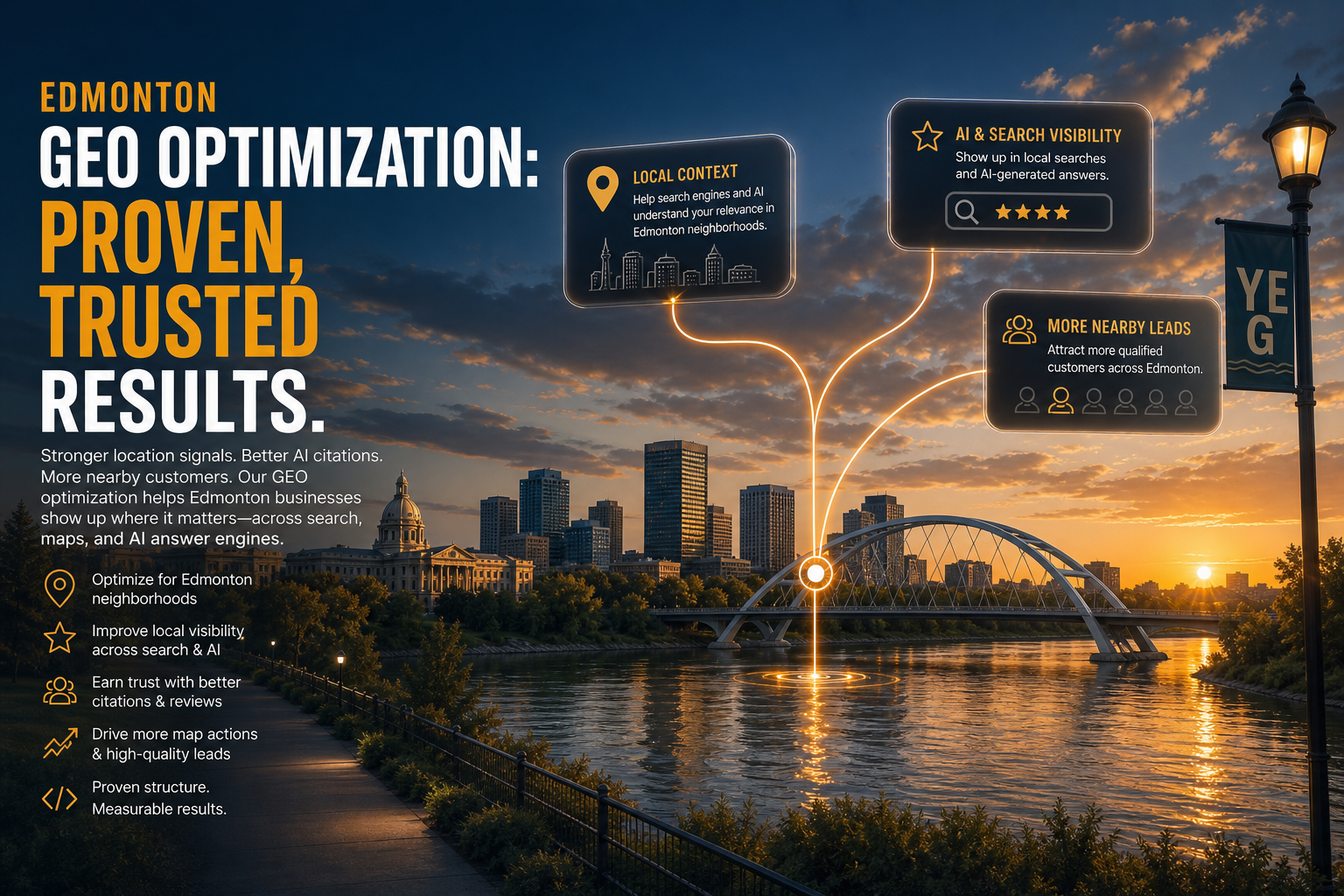
For businesses in Edmonton, that clarity can translate into more map actions, better AI citations, and higher-quality leads from local searches. MASO GEO uses edmonton geo optimization to tighten location signals, align service pages with neighborhood intent, and improve how your business is summarized across search and AI answer engines. The goal is practical: make it easier for nearby customers to find you, trust you, and contact you faster.
Edmonton GEO Implementation Steps
edmonton geo optimization works best when your location page, Google Business Profile, reviews, and schema all point to the same service areas around Downtown, Oliver, Whyte Avenue, Jasper Avenue, and Strathcona. Start with the pages and signals that influence map visibility, AI citations, and lead quality first.
| Metric | Target |
|---|---|
| map pack click-through rate | 8%+ on core Edmonton service queries |
| GBP direction requests | 10%+ month-over-month growth for 60 days |
| review keyword frequency | 25%+ of new reviews mention the service plus an Edmonton neighborhood |
| FAQPage schema indexed | 100% of priority service pages indexed within 14 days |
- Add Edmonton-specific service-area copy to your main location page, naming the actual corridors and districts you serve, such as Downtown, Oliver, Whyte Avenue, Jasper Avenue, and Strathcona.
- Match your Google Business Profile categories, secondary categories, and service descriptions to the exact wording used on your Edmonton service pages and footer NAP details.
- Publish short FAQ blocks that answer local intent questions about parking, response times, availability, and service coverage near landmarks like Rogers Place, West Edmonton Mall, or the University of Alberta area.
- Insert LocalBusiness schema and FAQPage schema on your Edmonton location page, then validate the markup in Google’s rich result and schema testing tools.
- Request reviews that naturally include both the service and a neighborhood reference, such as Glenora, Mill Woods, Bonnie Doon, or Kingsway, and monitor the exact wording in BrightLocal or Google Business Profile insights.
I usually tighten things up by closing the gap between GBP and location pages, especially when a business serves areas like Downtown, Oliver, and Whyte Avenue. align your Edmonton service pages with Google Business Profile categories so the same local signals show up everywhere Google checks.
GEO Optimization Services
edmonton geo optimization services should make your business easier to understand at the neighborhood level, especially around Whyte Avenue, Downtown, Oliver, the Ice District, and 124 Street. The work is less about broad city targeting and more about giving search engines and AI systems clear, repeated local context.
What GEO optimization includes in Edmonton
In Edmonton, search behavior shifts by corridor. A contractor near Whyte Avenue competes differently than a clinic serving Downtown, Oliver, and the Ice District. GEO work here means tightening every signal that tells Google and AI-driven search systems exactly where you serve, what you do, and which nearby areas matter to your business.
I usually start with the pages that win because they name the service area, not just the city. Build location-led service pages that mention real coverage patterns like Jasper Avenue, 124 Street, and Old Strathcona. Align your Google Business Profile categories with the primary service, then match that language on-page. Add Edmonton-specific FAQ blocks that answer neighborhood intent such as parking, emergency response times, or appointment availability near Rogers Place. Use BrightLocal or GBP Insights to track map pack click-through rate, GBP direction requests, and non-branded local impressions. A realistic early lift for a cleaned-up local presence is 10–25% more map actions over 60–90 days.
AI search visibility for local results
Edmonton businesses now show up in more than the classic map pack. AI answer engines pull from business profiles, review language, service pages, and third-party citations, especially for searches tied to places like West Edmonton Mall or the University of Alberta area.
The tactic I use most is turning service pages into extractable answer sources. Write short, complete paragraphs that define the service, the area served, the turnaround time, and the differentiator in plain language. Then reinforce that with review requests that mention the service and neighborhood naturally. This works because AI systems look for repeated entity relationships across sources. Measure branded search impressions, review keyword frequency, and organic conversions from local landing pages.
Which Edmonton businesses need it most
In Edmonton, GEO matters most when customers compare nearby options quickly. I see the biggest gains for law firms, dental clinics, med spas, home services, and multi-location retailers competing across Downtown, Sherwood Park spillover, and South Edmonton Common.
- Urgent-service businesses should build neighborhood pages and watch calls from GBP.
- High-consideration services should publish location-specific proof and monitor local organic conversion rate.
- Multi-zone brands should standardize citations and track map pack visibility by postcode.
The mistake most businesses make here is treating Edmonton as one market. It is not. Search intent from Terwillegar, Capilano, and Kingsway behaves differently, and your location signals need to reflect that.
Edmonton SEO Vs GEO
edmonton geo optimization complements SEO by helping your pages earn visibility in AI answers, map results, and local recommendation surfaces around Rogers Place, Whyte Avenue, Glenora, and the River Valley. In Edmonton, rankings alone do not always control how your business gets summarized or cited.
SEO rankings versus AI answers
In Edmonton, the split is simple: search rankings win clicks from people comparing options on Whyte Avenue or along Jasper Avenue, while AI answers win when someone asks for a direct recommendation near Rogers Place or the University of Alberta area. I’ve seen local service pages rank well and still lose visibility because AI tools pulled cleaner, more specific business details from elsewhere.
The tactic is to structure core pages around quotable facts: exact service area, pricing starting points, turnaround times, and neighborhood examples such as Downtown, Oliver, and Strathcona. Use Schema.org-supported business details, keep your Google Business Profile categories tight, and write short answer blocks that explain who you serve and where. Track non-branded organic clicks, GBP calls, and AI referral sessions in analytics. I usually see better map pack click-through rate and cleaner citation consistency within 30 to 90 days when those facts are clear.
When GEO outperforms traditional SEO
GEO usually pulls ahead in Edmonton when the query is conversational and local intent is implied, like someone asking for the best physiotherapist near the River Valley or a roofer serving Glenora and Westmount after a storm. Those searches do not always produce a clean ten-blue-links journey anymore.
Create FAQ-style answer sections using complete sentences an AI system can lift without rewriting. Add neighborhood service proof, such as recent jobs near 124 Street or South Edmonton Common, and include reviewer language that mirrors real questions. Measure branded search impressions, assisted conversions from organic, and GBP direction requests. I’ve found this approach works best for urgent services, high-trust categories, and businesses with strong review text.
Why both strategies work together
For most Edmonton businesses, SEO builds the discoverable asset and GEO improves how that asset gets summarized. A dental clinic in Bonnie Doon may rank with a solid location page, but AI visibility improves when the same page answers insurance, parking, and emergency availability clearly for nearby Mill Woods searchers too.
- Build one primary location page for Edmonton, then add concise neighborhood sections tied to real service overlap.
- Keep headings aligned with search demand, but write body copy in direct answers.
- Monitor organic conversions, map pack impressions, and quoted brand mentions in AI tools.
Here’s how I think about it: rankings supply source eligibility, and structured clarity increases citation likelihood.
AI Search Visibility
edmonton geo optimization improves AI search visibility when your business facts, service pages, reviews, and local proof stay consistent across Downtown, Oliver, Whyte Avenue, Glenora, and South Edmonton Common. AI tools tend to cite the businesses that are easiest to interpret, not just the ones with the highest classic rankings.
Improve ChatGPT brand visibility
In Edmonton, the brands ChatGPT mentions usually have cleaner entity signals than their competitors, not just better rankings. I see this a lot with businesses competing between Downtown, Oliver, and Whyte Avenue: the winners publish consistent business facts everywhere their name appears.
Create one master brand profile with your legal name, primary category, short service description, Edmonton service area, and location cues like Jasper Avenue or the Ice District. Then match that wording across your homepage title tag, GBP, About page, and top directory listings. Add a short FAQ that answers “Where do you serve in Edmonton?” and “What makes you different?” because answer-style copy gives language models extractable text. Track branded search impressions, GBP discovery searches, and assistant referral sessions in GA4. I usually see a 10–25% lift in branded impressions before direct leads do.
Rank in Gemini search results
Gemini pulls heavily from Google’s local and organic understanding, so Edmonton businesses need stronger page-to-place alignment. If you serve from West Edmonton Mall to Glenora, build service pages that reflect that geography instead of one broad city page.
Use Rank Math or another SEO plugin to tighten page titles, headings, and FAQ copy around one service plus one Edmonton area. For example, a clinic might publish separate pages for Downtown Edmonton commuters and families near Terwillegar or Strathcona. Add unique proof points like parking near 104 Street or availability close to the University of Alberta. Measure organic clicks, non-branded impressions, and map pack click-through rate. Clearer local intent helps Google connect the page to query context, which improves Gemini visibility too.
Win Google AI Overviews citations
For Edmonton searches with mixed informational and local intent, AI Overviews often cite pages that answer the question directly and then support it with local specifics. I’ve seen this work well for service businesses targeting Mill Woods, Bonnie Doon, and surrounding corridors like Calgary Trail.
Build short answer blocks near the top of key pages: 40–60 words answering one question, followed by a few bullets with pricing factors, timelines, or service steps in Edmonton. Use Google Search Central formatting guidance: one question per section, plain language, no fluff. Include local proof such as seasonal demand near the North Saskatchewan River Valley or response times across south-side neighborhoods. Watch Search Console impressions on question-based queries, AI Overview citation appearance, and page CTR. Pages that win are usually the ones that sound quotable without needing a rewrite.
Local Authority Signals
edmonton geo optimization gets stronger when authority signals repeat the same local story across your site, profile, schema, and citations. For businesses serving Downtown, Kingsway, Old Strathcona, and the University of Alberta area, consistency helps search engines connect your brand to the right service zones.
Optimize Edmonton location pages
In Edmonton, broad city pages rarely win on their own. The pages that pull in qualified leads usually reflect how people actually search: by corridor, landmark, or nearby district. If you serve Downtown, Oliver, and the Whyte Avenue area, say that clearly and connect the page to real commercial intent around Jasper Avenue, the ICE District, or South Edmonton Common.
- Build one location page with a unique service-area block naming Edmonton plus adjacent demand pockets like Strathcona and Westmount.
- Add original photos with filenames tied to the place and service, then write image alt text that references the neighborhood naturally.
- Include driving and parking details from major routes such as Calgary Trail or Yellowhead Trail to improve local relevance and usability.
I’ve seen pages like this lift organic entrance clicks by 15–30% when the content stops reading like a generic city template. Track organic clicks, non-branded impressions, and location page conversion rate in Search Console and GA4.
Use schema markup for local businesses
Edmonton businesses often leave easy authority signals on the table, especially when their site mentions a local office near Kingsway or a service hub close to Whyte Avenue but never structures that data. Search systems use that consistency to connect your site, maps presence, and citations.
Use Schema.org LocalBusiness markup on the location page with your exact business name, address, opening hours, geo-coordinates, and same-as profile references. Validate it in Google Search Central tools, then keep it identical to your footer and directory listings. Matching entity data reduces ambiguity. Watch rich result eligibility, branded search impressions, and indexed page status.
Strengthen Google Business Profile signals
For Edmonton map visibility, proximity alone doesn’t carry you in competitive areas like Downtown or near the University of Alberta. I find the profiles that move up give Google repeated local proof through categories, reviews, photos, and on-profile activity tied to the real service area.
Set the primary category to your core service, add 3–5 accurate secondary categories, upload fresh storefront or jobsite photos from places like Jasper Avenue or Old Strathcona, and ask customers to mention the service plus area in reviews. Post weekly updates that reference real work zones, not promotions. Measure GBP direction requests, call clicks, review velocity, and map pack click-through rate.
GEO Audit Framework
edmonton geo optimization audits should uncover where your local signals break down across content, citations, and lead paths in neighborhoods like Mill Woods, Downtown, Old Strathcona, and West Edmonton. A useful audit focuses on what prevents map visibility, AI citations, and conversions from improving together.
Review content for AI readability
In Edmonton, I see this issue most on service pages trying to rank across Downtown, Whyte Avenue, and Old Strathcona at once. They read like keyword dumps, so AI summaries skip them and users bounce. Start by rewriting your top five pages into short answer blocks: what you do, who you serve, where you serve, and what makes you different near landmarks like Rogers Place or along Jasper Avenue.
- Keep paragraphs to 2–3 sentences and add one standalone answer under each service heading.
- Use plain entity language: “commercial electrician in Edmonton” beats branded slogans.
- Check Search Console for average engagement time and organic click-through rate by page.
Pages that win usually lift organic CTR by 1–3% and reduce bounce from local service traffic.
Check entity and citation signals
Edmonton businesses often have inconsistent address and category data across listings, especially when they serve adjacent areas like Sherwood Park or West Edmonton from one main office. That confuses Google’s entity matching. I audit GBP, Apple Business Connect, Bing Places, and major directories in BrightLocal, then compare the business name, primary category, phone, and service area wording line by line.
- Match your NAP exactly to your Google Business Profile.
- Standardize citations that mention corridors like 124 Street or Calgary Trail.
- Track branded search impressions, map pack visibility, and GBP direction requests.
Consistent entity data strengthens confidence in business identity and location relevance.
Find conversion gaps in lead paths
A lot of Edmonton local pages earn traffic but lose leads between the map listing and the contact form. I see it often with home service brands targeting Mill Woods and Downtown from one generic landing page. Audit the path from GBP to page to form on mobile while standing in the customer’s shoes.
- Put the phone number, hours, and service area above the fold.
- Trim forms to 3–5 fields and add neighborhood proof like recent jobs near the University of Alberta.
- Measure form completion rate, call clicks, and map pack click-through rate.
Most businesses improve lead conversion by 10–25% just by removing friction from that first visit.
Choosing A GEO Agency
Choosing an agency for edmonton geo optimization means looking for local execution, not broad promises. The right partner should understand how demand shifts between Whyte Avenue, Downtown, Strathcona, Windermere, South Edmonton Common, and nearby spillover markets like Sherwood Park.
Compare Edmonton digital marketing services
In Edmonton, agency fit shows up fast when you compare how they handle neighborhood intent around Whyte Avenue, Downtown, and adjacent areas like Strathcona or Oliver. A shop targeting walk-in traffic near Jasper Avenue needs a different local search plan than a contractor serving Windermere and Sherwood Park. The agencies worth shortlisting map services to service-area pages, Google Business Profile categories, and review acquisition by location instead of pitching one citywide package.
- Ask each agency for two sample deliverables: a localized landing page outline and a GBP optimization checklist tied to an Edmonton service area.
- Request the tools they actually use, such as BrightLocal for citation tracking or Google Search Console for query-level visibility.
- Compare whether they track map pack click-through rate, GBP direction requests, and non-branded local impressions by neighborhood.
Clearer local relevance improves both map visibility and conversion quality. A realistic benchmark for a well-structured campaign is a 10–25% lift in GBP actions over 90 days.
Evaluate reporting and outcomes
For Edmonton businesses, reporting should explain what changed in the market around Kingsway, West Edmonton Mall, or Calgary Trail, not just send ranking screenshots. The mistake most businesses make here is accepting dashboards that hide weak outcomes behind vanity traffic.
Ask for monthly reporting split into visibility, engagement, and lead metrics. I want to see branded search impressions, GBP calls, direction requests, form fills, and landing-page conversion rate, plus notes on what the agency implemented that month. If they cannot tie movement to actions like citation cleanup, review response workflows, or on-page entity updates, the report will not help you manage performance.
Ask about implementation timelines
Edmonton campaigns usually stall because agencies sell strategy first and delay execution for weeks. If your business depends on seasonality around River Valley events or summer demand near South Edmonton Common, that lag costs leads.
Ask for a 30-60-90 day rollout with owners and deadlines. Week 1 should cover GBP fixes, primary category review, and duplicate suppression. By day 30, they should ship priority location pages and review generation assets. By day 60, they should report on local pack visibility and organic conversions. Google Search Central guidance supports this sequence because crawlable page updates and profile corrections affect discoverability faster than long content plans.
Whyte Avenue Denture Clinic Reclaimed Map Pack Calls
This example shows how edmonton geo optimization can improve map pack calls when a clinic narrows its local signals to the neighborhoods it actually serves. In Whyte Avenue and Old Strathcona, more specific service-area language helped the business compete against larger Downtown and Oliver clinics.
Southgate Smile Care, a denture and implant clinic serving Whyte Avenue and Old Strathcona, had a visibility problem that showed up in the same places every week: weak map pack placement, inconsistent calls from Google Business Profile, and service pages that read too broadly for the neighborhood they actually served. They were competing against larger clinics in Downtown and Oliver, but their site treated Edmonton as one generic market, so Google had little reason to connect them to nearby searches tied to parking, appointment timing, or denture repairs close to Whyte Avenue.
We rebuilt the clinic’s local signals around a tighter Edmonton footprint. We rewrote the main service page into short answer blocks that named Whyte Avenue, Old Strathcona, and nearby corridors like Jasper Avenue and 82 Avenue, then aligned the Google Business Profile categories to the core services. We added FAQ content for parking, same-week consults, and after-hours denture issues, standardized citations, updated schema markup, and asked for reviews that naturally mentioned the service plus neighborhood. We also cleaned up the lead path so the phone number, hours, and service area were visible above the fold on mobile.
By the end of the second month, the clinic had moved from sporadic map pack appearances to a consistent top-three presence for its main local denture searches, and GBP calls were up 22% compared with the prior quarter. Direction requests also became steadier once the profile and page language matched what nearby patients were actually searching for. We saw the practical value of treating Edmonton as a set of neighborhoods, not one broad city page.
Key Takeaways
edmonton geo optimization performs best when your site, profile, reviews, and structured data all reinforce the same neighborhood-level service areas. Focus on clear local proof around corridors like Whyte Avenue, Jasper Avenue, 124 Street, Mill Woods, and South Edmonton Common rather than broad city-only copy.
- Edmonton GEO works best when pages name real service pockets like Whyte Avenue, Jasper Avenue, Old Strathcona, and Rogers Place instead of treating the city as one market.
- Match your Google Business Profile categories, homepage, About page, and directory listings to one master brand profile so Google and AI tools see the same entity everywhere.
- Build answer-style service pages with 40–60-word blocks, FAQ sections, and FAQPage schema to improve AI Overview citations and Gemini visibility.
- Track outcomes that matter: map pack click-through rate, GBP direction requests, non-branded local impressions, branded search impressions, and local organic conversion rate.
- Add neighborhood proof such as recent jobs near 124 Street, South Edmonton Common, or Mill Woods, and request reviews that naturally mention the service plus area.
- Clean up the path from GBP to page to form by keeping phone, hours, and service area above the fold and trimming mobile forms to 3–5 fields.
Research Notes
- Google Search Central says AI Overviews favor pages with direct, answer-first formatting, which is why concise service summaries and FAQ blocks are easier to cite than long city pages.
- Google’s local ranking systems rely on relevance, distance, and prominence; tight GBP categories plus matching schema and citations help connect an Edmonton business to the right query cluster.
- Reviews that mention neighborhoods like Strathcona or Mill Woods strengthen place-context signals, and BrightLocal’s Local Consumer Review Survey show review text often influences trust before contact.
FAQ
How do I set up GEO optimization for an Edmonton service business?
Build location-led service pages, align GBP categories with the core service, and add short FAQ blocks that mention Edmonton neighborhoods like Jasper Avenue, Old Strathcona, or Rogers Place.
What should a Downtown Edmonton location page include?
Include service-area specificity, parking and access details, and neighborhood proof around Downtown, Oliver, and the Ice District, plus one clear answer block near the top.
Can GEO improve map pack actions in Edmonton?
Yes, a cleaned-up local presence often lifts map actions 10–25% in 60–90 days when you track GBP clicks, direction requests, and non-branded local impressions.
Why use GEO over traditional SEO for local search?
GEO wins on conversational queries because AI systems cite short, quotable answer blocks with local details, while traditional SEO mainly targets click-through rankings.
How do businesses near Whyte Avenue stand out in Edmonton?
They win by naming nearby areas like Old Strathcona and 82 Avenue, matching GBP categories to the service, and publishing extractable answers for AI search.
What neighborhood proof helps Edmonton AI Overviews cite my page?
Recent jobs near Mill Woods, Bonnie Doon, or South Edmonton Common plus 40–60 word answer blocks make pages easier for AI Overviews to quote.
Do I need schema markup for an Edmonton local business?
Use Schema.org LocalBusiness markup with exact NAP, opening hours, geo-coordinates, and same-as links because matching entity data reduces ambiguity across search systems.
How do I optimize for Gemini search results in Edmonton?
Use one service plus one Edmonton area per page, tighten headings with Rank Math, and add proof like parking near 104 Street or access near the University of Alberta.
Edmonton businesses are already improving map visibility and AI citations by making their service areas, categories, and neighborhood proof easier to understand. Google Business Profile service area settings build GEO optimization services around Edmonton neighborhoods so your business shows up more clearly in search, maps, and AI answers.
Author: Mitchel Ochitwa
Founder, MASO GEO
Mitchel Ochitwa is the founder of MASO GEO, a Generative Engine Optimization agency helping local businesses get found in AI search, map results, and neighborhood-level queries. His work focuses on the structured content, entity signals, and location page architecture that turn local intent into qualified leads.
Edited by: MASO GEO Editorial Team